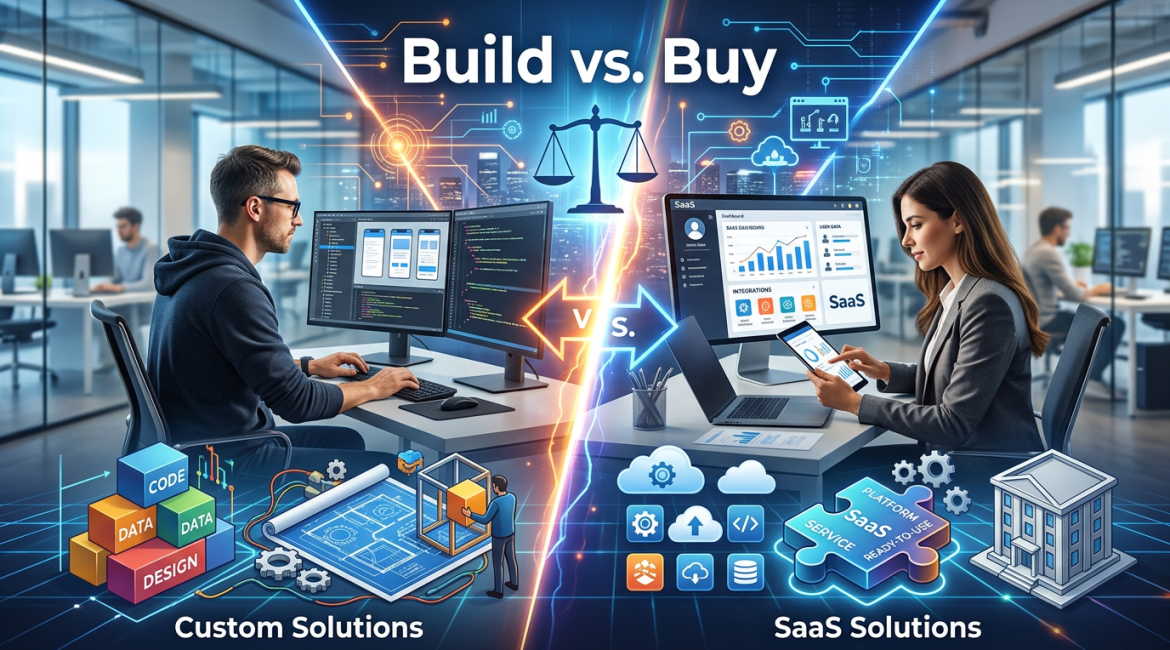
Deciding between building a custom software solution or buying an off-the-shelf SaaS product depends on your specific business requirements, budget, and timeline. Buying is generally faster and more cost-effective for standard business processes, while building offers total control and a unique competitive advantage for proprietary operations that generic software cannot support.
Should you build or buy software for your business?
You should buy software when your needs are standard, such as for payroll, email, or basic CRM functions, as this minimizes upfront costs and maintenance. You should build custom software when your business process is a unique source of competitive advantage that requires specific features not available in the commercial market.
The “Build vs. Buy” dilemma is a foundational strategic decision for modern businesses. In the current market, SaaS (Software as a Service) providers offer sophisticated tools for almost every vertical. However, as a business grows, generic tools may become a bottleneck, leading leaders to consider developing internal solutions. Understanding the total cost of ownership, including long-term maintenance, is essential to making the right choice.
What are the primary benefits of buying SaaS products?
The primary benefits of buying SaaS products include rapid deployment, lower initial costs, and handled maintenance through the vendor. Most SaaS platforms can be implemented in hours or days, allowing businesses to solve immediate problems without hiring a development team.
- Predictable Costs: Monthly or annual subscription fees make budgeting simpler.
- Automatic Updates: Vendors handle security patches, feature updates, and server uptime.
- Community Support: Popular tools have extensive documentation, tutorials, and third-party integrations.
- Lower Risk: You can trial the software before committing, reducing the risk of a failed project.
What are the main advantages of building custom software?
Building custom software provides complete ownership over the product roadmap, allowing you to tailor every feature to your specific workflow. This approach eliminates unnecessary “feature bloat” and ensures the software integrates perfectly with your existing legacy systems.
Custom software is often an investment in IP (Intellectual Property). If your business operates a logistics network with a proprietary routing algorithm, a standard tool might not support your logic. By building, you ensure that competitors cannot simply subscribe to the same advantage you have. Furthermore, you avoid “vendor lock-in,” where a third-party provider might raise prices or discontinue a critical feature your business relies on.
How do the costs of building compare to buying?
Buying software typically involves a lower upfront cost but incurs ongoing subscription fees that can scale significantly with user count. Building software requires a high initial capital investment for development, followed by annual maintenance costs usually estimated at 15% to 20% of the initial build cost.
To calculate the true cost, a business must look at a five-year horizon. A SaaS product costing $5,000 per month equals $300,000 over five years. A custom build might cost $200,000 upfront but require $40,000 annually for hosting and updates, totaling $400,000 over the same period. The decision rests on whether the $100,000 difference is justified by increased efficiency or unique capabilities.
When is a hybrid approach the best solution?
A hybrid approach is best when you use a core SaaS platform for standard functions and build custom extensions or integrations for your unique business logic. This strategy leverages the stability of established platforms while providing the flexibility of custom-coded modules via APIs.
Many modern businesses use “headless” SaaS products. For example, an e-commerce company might use a standard payment processor like Stripe but build a custom front-end storefront to provide a unique user experience. This allows the business to focus its development budget only on the parts of the software that truly matter to the customer.
What are the risks of building your own software?
The risks of building custom software include project delays, budget overruns, and the long-term burden of technical debt. Statistics suggest that large software projects often exceed their initial budgets by over 50% and take significantly longer than planned to reach a stable release.
Additionally, the business becomes responsible for all security compliance and bug fixes. If the lead developer leaves the company, the business may struggle to maintain the code. Buying a SaaS product transfers these technical risks to the vendor, who employs full-time teams to ensure the software remains secure and functional.
Frequently asked questions
Which is faster to implement, building or buying?
Buying an off-the-shelf SaaS product is significantly faster, often taking minutes to set up an account. Building a custom solution typically takes three to nine months for an initial version, depending on the complexity of the requirements and the size of the development team.
Does custom software provide a better ROI?
Custom software provides a better ROI if it directly increases revenue or saves significant labor hours that a standard tool cannot. However, for non-core functions like accounting or internal messaging, the high cost of development rarely outperforms the value of a low-cost SaaS subscription.
What is “vendor lock-in” in software?
Vendor lock-in occurs when a business becomes so dependent on a SaaS provider’s proprietary data formats or features that switching to another service is too expensive or difficult. Building custom software avoids this by giving the business full control over its data and technology stack.
How much does it cost to maintain custom software?
Standard industry estimates suggest that annual maintenance for custom software costs between 15% and 20% of the original development price. These costs cover server hosting, security updates, fixing bugs, and ensuring compatibility with new operating systems or third-party API changes.